Monologue or Soliloquy: Who Is Being Addressed?
Monologue or soliloquy: learn to track who can hear a speech, what the listener changes, and how that choice reshapes the scene in performance.

A monologue can be spoken to another character; a soliloquy usually lets the audience hear a character thinking aloud without an in-scene listener. That distinction matters because the imagined listener changes a speech’s pressure: a confession, a warning and a private reckoning may use the same words but land very differently. To tell monologue or soliloquy apart, watch who can hear the speaker and what the speech is trying to make happen.
The Listener Test
Start with the people present in the scene. If another character is meant to hear the speech, the speaker has an audience inside the story, even if nobody answers. The speech may persuade, threaten, explain, entertain or conceal.
A soliloquy, in the usual theatrical sense, is addressed to no other character onstage. The audience hears the speaker’s thoughts, but fellow characters do not. That convention gives spectators privileged access: they know something the people around the speaker cannot know.
The labels are useful, not magical. Playwrights and productions can bend conventions, and a long speech may contain shifts in address. Rather than relying on length or emotional intensity, ask a practical question: who, within the scene, is supposed to hear these words?
Track the listener before you decide what the speech means.
Monologue As Action
A monologue is an extended speech by one character. It might be delivered to a single person, a group, or—in a play with direct audience address—to the spectators themselves. The defining feature is the sustained turn of speech, not an automatic promise that the speaker is alone.
Because another listener may be present, a monologue can operate as a contest. A character might give a polished account while watching for a reaction, leave out a damaging detail, or use a story to soften a request. The listener’s silence is still part of the exchange: a held gaze or a turn away can make the speaker revise course.
Imagine a council member standing before a colleague and defending a decision to close a community hall. The colleague listens without interrupting, then reaches for the keys; the speaker’s carefully measured explanation now sounds less like private reflection and more like a final attempt to hold the room. The imagined result is visible in the scene’s relationship, not merely in the speech’s length.
In performance, listen for words that assume shared knowledge: “you remember”, “as we agreed”, or “you said”. Such phrases can reveal whom the speaker is targeting, even when the speech appears to address everyone present.
Soliloquy As Access
A soliloquy gives a character space to speak thoughts that are not intended for another character to hear. The audience becomes the listener by theatrical arrangement, not necessarily because the character turns and addresses the seats directly. The speech may feel candid, but it is still written and performed for an audience.
That access can sharpen dramatic irony. Spectators may hear a plan, fear or contradiction while the other characters continue to act on incomplete information. The gap between what the audience knows and what the characters know creates tension without requiring a chase or argument.
A soliloquy is not simply “the truth” of a character. Someone alone can still deceive themselves, dodge a thought or speak in a deliberately shaped way. Notice whether the language moves towards a decision, circles around a fear or breaks off when an uncomfortable idea comes close.
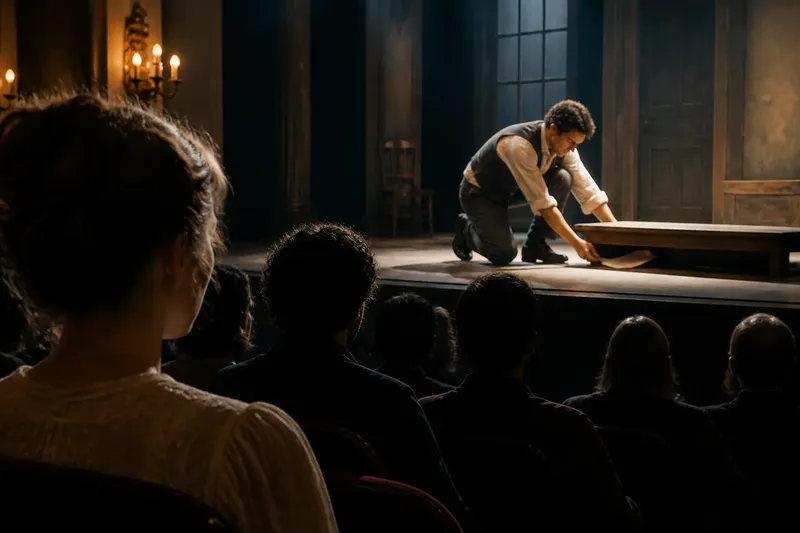
Silence and movement matter here too. A speaker who avoids a letter on a table may reveal resistance more vividly than a line announcing it. Treat the words and the visible action as parts of one event.
Listening Over Time
Use a simple routine across a week of reading or watching plays. It keeps attention on address rather than turning every long speech into a vocabulary quiz.
- On the first reading: mark every character who is physically present during a substantial speech. Note entrances and exits that change who could hear it.
- On the next pass: underline direct forms of address, such as a name, “you”, or a collective “you all”. Ask whether each one points to a character, the audience or both.
- Midweek: write down what the speaker seems to want from a listener. Choose an action verb such as persuade, warn, confess, distract or decide.
- Later in the week: check the stage directions and the responses that follow. A glance, interruption or sudden change of subject may confirm that another character heard the speech.
- At the end of the week: revisit one uncertain passage and compare two possible listeners. Describe how each reading would alter the scene’s tension, then keep the interpretation that best fits the text and performance.
This is a way to notice choices, not a rule for classifying every speech. A play may deliberately leave the audience unsure whether a character is speaking privately, performing for someone nearby, or letting spectators in on a thought.
Questions About Address?
Can a monologue address the audience?
Yes. A character may speak directly to spectators, making them the immediate audience of the speech. The play may treat that address as a theatrical convention rather than as a conversation heard by the other characters.
Can a soliloquy include a question?
Yes. A character can ask a question aloud without expecting another person in the scene to answer. The question may expose uncertainty, organise thought or invite the theatre audience to consider the same dilemma.
Does a long speech have to be a monologue?
It is often described as one because the term refers to an extended speech by one speaker. But length alone does not tell you who can hear it or whether the speech is private; those details come from the scene’s staging and conventions.
What if the listener is unclear?
Keep the uncertainty rather than forcing a label. Notice where the speaker looks, what happens immediately afterwards and whether the words depend on another character’s knowledge. An ambiguous address may be an intentional part of the scene’s effect.
Words Into Performance
Directors and actors make address legible through choices that can be small. A speaker may hold eye contact with one character, scan a crowd, turn away from everyone or face out towards the auditorium. Each choice gives the words a different destination.
Sound also shapes the listener. A low, inward delivery can suggest private thought, while a voice projected across a room may turn a personal speech into a public claim. Neither vocal style settles the classification on its own: a quiet warning can still be meant for another character, and a projected soliloquy can remain unheard by the fictional world.
When watching, follow the response as carefully as the speech. Does someone flinch, interrupt, move closer or carry on unaware? The scene’s consequences often tell you more about who heard than a label in a programme or a line of stage direction.
When Forms Overlap
Some speeches shift audience midway through. A character may begin by addressing a companion, then turn towards spectators for a private aside, or speak to a group while letting the audience hear a second meaning underneath. These changes can make a speech feel like both communication and exposure.
For a close reading, divide the passage at the point where its listener or purpose changes. Ask what new information becomes available, who is excluded, and whether the speaker’s aim has altered. This gives you a more precise account than calling the whole passage either “a monologue” or “a soliloquy” and stopping there.
The distinction between monologue or soliloquy is most useful when it helps you hear a relationship: one person trying to reach another, or a character’s thought opened to the audience while others remain outside it. Next time a speech holds the stage, look beyond its length. Follow the words to their listener, then watch what that listener’s presence—or absence—does to the room.