When Audiences Learned to Sit in the Dark
Theatre auditorium darkness has a specific history: trace how changing light shaped audience attention, then read what a production’s shadows ask you to notice.
Theatre auditorium darkness became a theatrical convention through changing lighting technology and artistic choices, not through a single switch flipped everywhere at once. In a candlelit playhouse, spectators could often see one another; in a modern production, a dimmed house may turn attention towards a face, a gesture or a sudden silence.
That difference is not merely practical. The light in the auditorium affects whether spectators feel like a visible crowd, concealed observers or participants whom a performer can address. To understand the convention, it helps to separate the varied conditions of earlier theatres from the later ability to control stage and audience light independently.
Visible audiences
Before electric lighting, theatrical rooms used the light available to them: daylight in some settings, and candles, oil lamps or other flames in others. The precise conditions varied with the building, performance time and local practice. It would be misleading to imagine one universal arrangement in which every earlier audience sat fully lit, just as it would be wrong to assume that every theatre later adopted complete darkness.
In many playhouses, however, spectators could see other spectators as well as the performers. Watching a scene and noticing the people around you could happen together. The audience’s responses and social presence were part of the occasion, rather than hidden behind a dark visual boundary.
That visibility could serve different dramatic purposes. A performer addressing a lit house might turn the audience into an acknowledged part of the event; a spectator’s glance or reaction might be as noticeable as the stage action. The room was not simply a picture framed for silent inspection.
Lighting gains control
Gas lighting and, later, electric systems changed what theatres could do with illumination. Their adoption was gradual and uneven, and the possibilities depended on each building’s equipment. The significant shift was the growing capacity to control light during a performance and to distinguish, more deliberately, between the stage and the auditorium.
With that control, dimming the seating area could become a cue in its own right. A change in brightness might narrow attention, mark a transition or make a performer’s expression easier to read. Darkness was no longer only an unavoidable limit of the room; in equipped theatres, it could be shaped as part of the production.
This was not a simple march from bright rooms to dark ones. Theatres have continued to use different lighting arrangements, and directors may choose visible house lights, partial dimming or darkness according to the work and the venue. Technology made new choices possible; it did not dictate one correct choice.
Attention and spectatorship
A dark auditorium can make the stage feel visually separate from the seats. Detailed scenery or a small gesture may draw more focus when the surrounding room recedes, while a gradual fade can help signal that the scene is changing. Yet darkness also changes the audience’s sense of itself: spectators may feel less exposed to one another, even as they become more conscious of the stage as the room’s centre.
Sound makes that shift especially clear. In a dark house, a laugh or cough can seem to emerge from an unseen crowd. The audience is still present, but its faces are harder to read; a performer’s direct address may consequently feel intimate, unsettling or one-sided.
A lit auditorium creates different possibilities. Spectators can register one another’s reactions, and the performer can acknowledge the room as a visible gathering. Neither arrangement is automatically more realistic or more engaging. Each gives the audience a different position in relation to the action.
Why does theatre auditorium darkness matter?
Did every early theatre keep its audience lit?
No single description fits every period, building or performance. Earlier theatres used varied sources and arrangements of light, so audience visibility differed rather than following a universal rule.
What did electric lighting make possible?
Electric systems gave theatres greater scope to control stage and auditorium illumination separately, though adoption and equipment varied. This made planned contrasts and changes in light more available as theatrical choices.
Does a dark house make a play realistic?
Not by itself. Darkness can make a stage picture feel self-contained, but it can also draw attention to the audience’s role as unseen observers; the effect depends on the performance and its conventions.
Can a production leave the audience visible?
Yes, if the venue’s equipment and the production allow it. A company might keep house lights up, dim them only partly or bring them back at a chosen moment, making spectators’ visibility part of the event.
One search scene
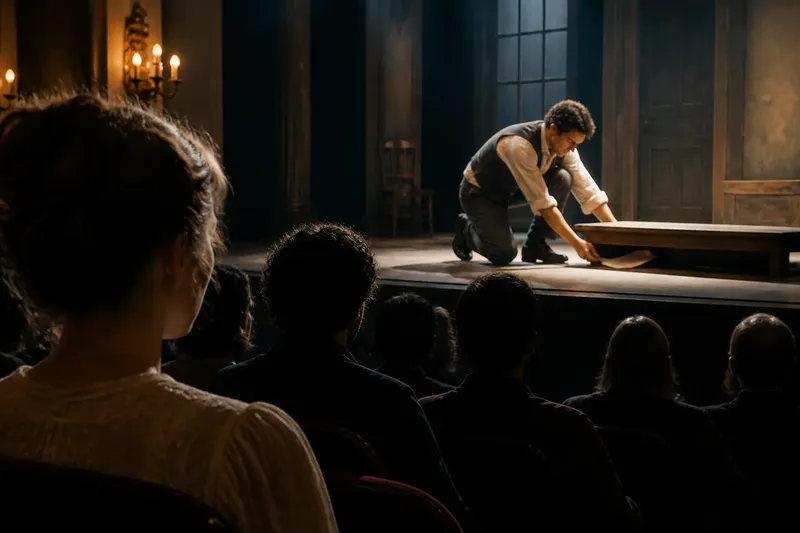
Imagine a company staging a scene in which an actor searches beneath a bench for a note. Its starting conditions are straightforward: the venue can keep the house lights steady or dim them, and the actor’s search is the scene’s main action.
The company first rehearses with the house lights steady. The actor reaches beneath the bench and finds the note; spectators can see one another as well as the performer. The expected observable effect is a public, shared search, with the audience’s reactions remaining visible.
Next, the company tries a gradual dim as the actor begins searching. The actor finds the same note, then looks towards the seats before opening it. The expected effect is a tighter focus on the performer, followed by a moment in which spectators may feel the actor has noticed them, though their faces are difficult to see.
Finally, the company compares those choices with a full blackout during the search. The note may attract concentrated attention when the lights return, but the audience loses the visible connection with the room. The trade-off is clear: steady light favours shared visibility, partial dimming balances focus with awareness of the audience, and darkness makes the stage feel more isolated.
Reading the room
When you enter a theatre, notice whether the seats are visible before the performance and what changes when the action begins. A gradual fade, a sudden blackout or an unchanged house tells you something about how the production wants attention to move.
Look, too, at what happens when an actor speaks directly to the audience. If the house is lit, the exchange may feel openly social; in darkness, it may feel private or unnerving. Theatre auditorium darkness has a history shaped by uneven technological change and artistic choice, and its practical meaning remains visible in the relationship between stage, room and spectator.