The Myth That Every Pause Is a Hidden Clue
Learn how to read a pause in theatre without forcing a secret meaning: notice its rhythm, the actor’s breath and what changes when speech resumes.
A pause in theatre is not automatically a confession in disguise. When an actor stops speaking, the room still has sound, breath and expectation; the useful question is what the silence does to the scene, not what secret it must contain.
That distinction matters because audiences are trained to hunt for significance. A held look can feel like a locked box, and a quiet beat can tempt us to invent its contents. Sometimes there is a revelation. Sometimes the character is listening, choosing a word, or simply drawing breath before the next line.
Start with the rhythm
Notice where the silence lands. Does it break a sentence, arrive after a joke, or open a gap between one person’s question and another’s reply? Its position gives you a firmer clue than the mere fact that nobody is speaking.
A pause after a sharp question may make the answer feel delayed or difficult. The same length of silence after a comic line can give the audience room to laugh. In either case, the pause shapes timing; it need not conceal a separate piece of plot.
Listen for the change when speech begins again. A rushed answer, a quieter voice or a sudden change of subject may make the preceding gap feel charged. If the conversation resumes in the same tone and direction, the silence may have served as a simple beat in the exchange.
Follow the scene’s pace before assigning a motive.
Watch the breath
Actors need breath, and performance makes that ordinary bodily fact audible and visible. A quiet inhale before a long line may be preparation rather than a character’s plan; a breath released after a difficult phrase may mark effort without announcing a hidden truth.
Breath can still carry dramatic meaning. A character who begins to speak, stops, then exhales instead has made an observable change: speech was possible, but did not happen. What caused that change may remain uncertain, and the performance can leave the audience with that uncertainty rather than resolving it for them.
Try separating what you see from what you infer. “She takes a breath and looks towards the door” is an observation. “She is afraid someone will enter” is one possible reading. Keeping both in view lets you respond to the performance without mistaking your interpretation for a fact established by the scene.
Track the hesitation
Hesitation often becomes legible through its shape. A character might begin a sentence, abandon it, and start again; another might answer promptly but use a phrase that dodges the question. Those choices can suggest reluctance, uncertainty or tact, but context decides how strongly each possibility fits.
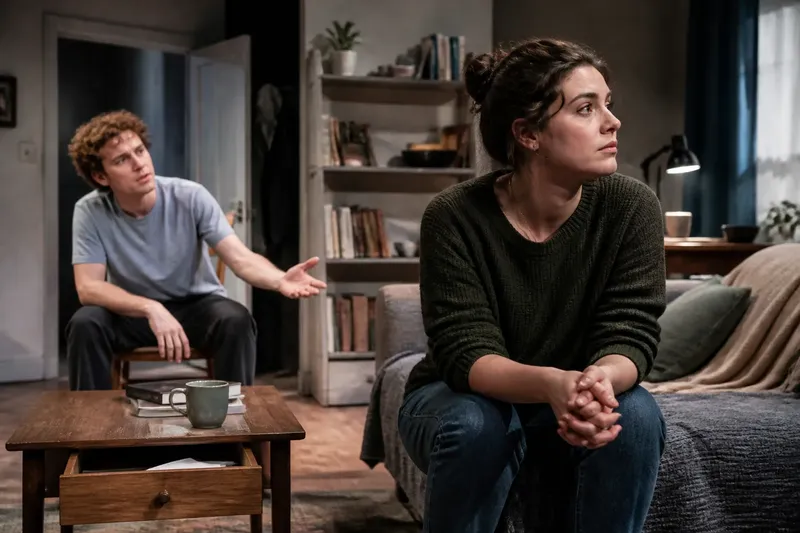
Imagine a fictional scene in which one flatmate asks, “Did you read the letter?” The other pauses, glances at a half-open drawer, and says, “I saw the envelope.” The glance and evasive answer give the pause a clear relation to the conversation. They do not prove what was read, or why the character avoided answering.
In a different scene, the same pause might be a search for precise wording, particularly if the character goes on to give a careful, direct reply. Attend to what follows instead of pinning a single emotion to the silence before the next line arrives.
Notice the room
A pause belongs to the whole stage, not only to the person who has stopped talking. Another actor may turn away, a chair may scrape, or a distant sound may become suddenly noticeable. The audience may also shift, cough or settle; a live performance includes that shared room, even when the script contains no marked silence.
Stage directions can offer a useful distinction. A script may specify a pause, a beat, a look, or a character listening, while a performance may stretch or shorten that moment. The direction tells you what action is indicated; it does not necessarily supply a psychological explanation.
Notice whether the silence changes the focus of attention. If the scene draws your eye to an empty doorway or a partner who has been ignored, the pause may redirect attention rather than deliver a clue about the speaker’s thoughts.
When does silence matter?
Does a pause always reveal a character’s feelings?
No. It can show a feeling, but it can also organise timing, make space for listening or allow an actor to breathe. Look for supporting changes in speech, action or the relationship between characters before settling on an emotional reading.
What is the difference between a beat and a long pause?
In scripts and rehearsal rooms, a beat often means a brief unit of dramatic time rather than a precise duration. A longer pause may give an audience more time to notice a reaction or wait for an answer, though the terms are not used identically in every production.
How can I tell whether a silence is deliberate?
You can rarely know from silence alone, and a moment that feels spontaneous may be carefully timed. Look for a repeatable pattern: a question left unanswered, a reaction held in view, or a clear shift in the scene’s pace can make the pause function as part of the performance.
Should I look for symbolism in every quiet moment?
Stay open to symbolism without requiring it. A silence may gain significance through contrast or repetition, but an ordinary breath does not become a coded message merely because the stage is quiet.
Keep the question open
When a pause catches your attention, hold two or three readings lightly: perhaps the character is choosing, listening, avoiding, or waiting. Then notice which reading the next line or action supports, and which details remain unexplained.
This is a useful way to read a pause in theatre: treat the timing, breath and visible action as evidence, while leaving room for ambiguity. A silence can matter without carrying a secret, and its most revealing effect may be the expectation it creates in the audience.